
| ⚡ Quick Answer A zero-click search occurs when a user gets their answer directly on Google’s search results page — via an AI Overview, Featured Snippet, or Knowledge Panel — without visiting any website. To combat this, focus on: (1) appearing inside AI Overviews as a cited source, (2) targeting high-intent commercial keywords, (3) winning featured snippets for brand visibility, (4) building direct brand search volume, and (5) diversifying traffic beyond Google. |
Table of Contents
- What Are Zero-Click Searches? (Definition + Data)
- Why Zero-Click Searches Are a Serious SEO Threat
- 7 Proven Strategies to Win in a Zero-Click World
- AEO: Optimizing for Answer Engines, Not Just Search Engines
- E-E-A-T Signals That Help You Stay Cited
- Schema Markup Recommendations
- Frequently Asked Questions
1. What Are Zero-Click Searches? (Definition + Data)
A zero-click search happens when Google answers a user’s query directly on the search results page (SERP)—eliminating the need to click through to any website. The user reads the answer, satisfies their intent, and leaves.
Zero-click results appear in several formats:
- Google AI Overviews — AI-generated summaries shown above organic results since 2024
- Featured Snippets — The “answer box” or “position zero” result above organic rankings
- Knowledge Panels — Entity cards for brands, people, and places
- Google Maps & Local Packs — For location-based queries
- Calculator, weather, currency & dictionary tools — Google’s built-in utility features
- People Also Ask (PAA) boxes — Expandable Q&A directly in the SERP
| 📊 Key Data Point According to SparkToro and Datos research (2024–2025), over 65% of Google searches in the US now end without a single click. For informational queries — “what is,” “how to,” “define” — the zero-click rate exceeds 75%. This is not a future problem. It is the current reality. |
2. Why Zero-Click Searches Are a Serious SEO Threat
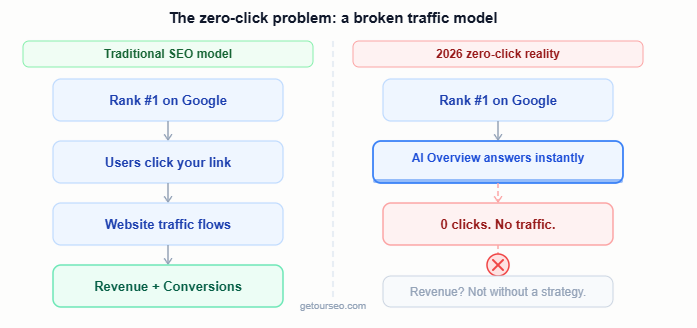
Traditional SEO operated on a clear value chain: rank higher → earn more clicks → generate more traffic → convert visitors → drive revenue. Zero-click searches have broken this chain at the most critical point.
You can rank #1 organically and still receive negligible traffic if Google’s AI Overview answers the question above your listing. This directly impacts:
- Informational blog posts targeting ‘what is’ and ‘how to’ queries
- FAQ-style pages and definition content
- Top-of-funnel awareness content
- News and trending topic coverage
The Paradox: More Visibility, Fewer Clicks
Here’s what makes zero-click SEO uniquely challenging: your content may be referenced inside the AI Overview — giving you brand visibility — without generating a single click. This decouples impressions from traffic in a way traditional SEO never accounted for.
Smart SEOs are treating this not purely as a threat, but as a new form of brand advertising — one where visibility must be measured differently than organic clicks alone.
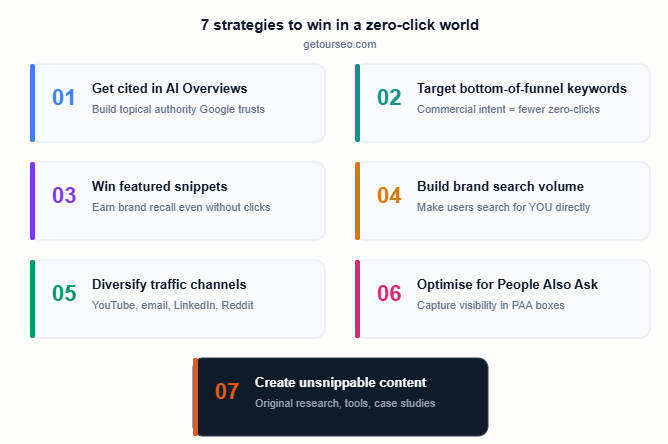
3. Seven Proven Strategies to Win in a Zero-Click World
Strategy 1: Optimize to Appear INSIDE the AI Overview
If you cannot beat the zero-click, the next best outcome is being cited inside it. Google’s AI Overviews frequently pull from authoritative, well-structured sources. When your brand appears as a cited reference in an AI Overview, millions of users see your name — even without clicking.
How to get cited in AI Overviews:
- Build deep topical authority — cover your subject comprehensively, not superficially
- Structure content clearly with direct answers in the opening paragraph
- Use concise, factual language — avoid vague marketing-speak
- Earn backlinks from authoritative industry publications
- Maintain consistent E-E-A-T signals across your entire site
Strategy 2: Shift Focus to Bottom-of-Funnel Keywords
Informational keywords are the most vulnerable to zero-click. Queries like ‘what is SEO’ or ‘how does Google work’ are almost always answered in a snippet or AI Overview today.
Commercial and transactional keywords, on the other hand, remain far more click-friendly. Users searching ‘best SEO agency in Delhi‘ or ‘hire freelance SEO consultant India’ are in buying mode — Google cannot close that intent with a paragraph of text.
| 🎯 Tactical Shift Audit your existing content and categorize every keyword by intent: Informational / Commercial / Transactional / Navigational. Migrate your content investment away from pure informational queries and toward commercial comparison, service-based, and transactional pages where zero-click rates are significantly lower. |
Strategy 3: Win Featured Snippets Strategically
Even in a zero-click environment, appearing in the featured snippet creates powerful brand recall. Research consistently shows that users remember the brand name in a featured snippet even when they don’t click — and are significantly more likely to search for that brand directly later.
To optimize for featured snippets:
- Answer the target question directly and concisely in your opening paragraph (40–60 words for paragraph snippets)
- Use numbered or bulleted lists for ‘how to’ and ‘best of’ queries
- Use definition-style sentences starting with the query term for ‘what is’ queries
- Add a question as an H2 or H3 heading immediately followed by the answer
- Keep your page load speed high — Google prefers fast, technically sound pages for snippets
Strategy 4: Build Direct Brand Search Volume
The most algorithm-proof traffic is direct and branded. When users see your brand name cited repeatedly in AI Overviews and featured snippets optimization, brand recall accumulates. They start searching ‘Get Our SEO’ instead of ‘SEO consultant Delhi’ — bypassing Google’s SERP entirely.
Brand search volume is also a powerful E-E-A-T signal that Google’s Quality Raters and algorithms use to assess authority. Growing it directly improves your organic performance.
Tactics to build brand search: publish consistently under your brand name, maintain an active email list, appear in industry podcasts and publications, and use retargeting to stay top-of-mind.
Strategy 5: Diversify Traffic Sources
Over-reliance on Google is now a significant business risk. A robust 2026 traffic strategy uses Google as one channel among many:
- YouTube SEO — Video content still generates strong click-through to websites. Tutorial and how-to content performs especially well.
- Email marketing — Your list is the only audience you truly own. An engaged subscriber base provides traffic that no algorithm can take away.
- LinkedIn & social media — B2B and professional audiences are highly reachable through LinkedIn content and newsletters.
- Quora, Reddit & community platforms — Participate where your audience asks questions. These platforms send targeted, high-intent traffic.
- AI platform visibility (ChatGPT, Perplexity, Gemini) — Ensure your brand appears as a cited source in AI chatbot responses, which is the next frontier of zero-click.
Strategy 6: Optimize for ‘People Also Ask’ Boxes
PAA boxes appear in a large percentage of SERPs and function similarly to featured snippets — your brand name is displayed even if users don’t click. Optimizing for PAA requires mapping out the question ecosystem around your primary keywords and creating dedicated Q&A sections that match the exact phrasing of those questions.
Strategy 7: Create Genuinely Unsnippable Content
Certain content types are structurally difficult for Google to summarize in a snippet: original research with proprietary data, in-depth case studies, interactive tools (calculators, auditors), and product comparison pages with unique first-hand reviews. Investing in these content types creates a natural barrier to zero-click displacement.
4. AEO: Optimizing for Answer Engines, Not Just Search Engines
Answer Engine Optimization (AEO) is the practice of structuring your content so it can be accurately interpreted and served by AI-powered answer systems — including Google AI Overviews, Perplexity, ChatGPT search, and Bing Copilot.
AEO goes beyond traditional on-page SEO. It focuses on:
- Semantic clarity — write sentences that are unambiguous and factually precise
- Entity coverage — mention the key entities (people, places, brands, concepts) associated with your topic
- Direct Q&A format — structure at least one section of every article as a clear question followed immediately by a clear answer
- Structured data markup — use FAQPage, HowTo, and Article schema to make content machine-readable
- Source authority — earn citations and backlinks from sites Google already trusts as authoritative
| 💡 AEO vs SEO Traditional SEO optimizes for ranking position. AEO optimizes for answer inclusion. In a zero-click world, being position #1 matters less than being the answer. Aim to be the source, not just the result. |
5. E-E-A-T Signals That Help You Stay Cited
Google’s E-E-A-T framework — Experience, Expertise, Authoritativeness, and Trustworthiness — is central to whether your content is trusted enough to appear in AI Overviews SEO and featured snippets. In 2026, E-E-A-T is not a nice-to-have; it is the price of entry for high-visibility positions.
Experience
Demonstrate first-hand experience by including personal case studies, client examples, screenshots, and results data. Generic content produced without real experience is increasingly filtered out by Google’s quality systems. Phrases like ‘In our experience working with e-commerce clients in Delhi…’ signal lived expertise.
Expertise
Establish author credentials clearly on every article: name, professional title, years of experience, and a link to an author bio page. For YMYL (Your Money or Your Life) topics — health, finance, legal, and, yes, digital marketing decisions — this is especially critical.
Authoritativeness
Authority is largely built externally: backlinks from respected industry publications, brand mentions in reputable SEO and marketing outlets, speaker credits, and consistent presence on platforms like LinkedIn and industry forums.
Trustworthiness
Publish accurate, up-to-date statistics with named sources. Maintain HTTPS and a secure, fast website. Include a clear About page, contact information, and privacy policy. Correct outdated posts with visible ‘Last Updated’ dates rather than leaving stale content live.
6. Schema Markup Recommendations
For this article type, implement the following JSON-LD schema in the page <head> to maximize eligibility for rich results and AI Overview citations:
| 🔧 Recommended Schema Types 1. Article schema — Marks the page as a substantive editorial piece. Include ‘author’, ‘datePublished’, ‘dateModified’, ‘publisher’, and ‘image’. 2. FAQPage schema — Automatically makes each FAQ item eligible for Google’s FAQ rich result, and signals to AI systems which questions you directly answer. 3. BreadcrumbList schema — Improves site architecture understanding and can appear directly in the SERP URL display. |
7. Frequently Asked Questions
The following FAQs are optimized for AEO — each answer is concise (40–60 words) to maximize eligibility for featured snippets and AI Overview citation.
| Q: What is a zero-click search? A: A zero-click search occurs when a user finds their answer directly on Google’s search results page — through an AI Overview, Featured Snippet, Knowledge Panel, or built-in tool — without clicking through to any website. Over 65% of all Google searches in 2025–2026 end without a click. |
| Q: Are zero-click searches increasing in 2026? A: Yes. With the expansion of Google AI Overviews across global markets in 2024–2025, zero-click search rates have increased significantly. Informational queries are most affected, with zero-click rates exceeding 75% in that category. The trend is expected to continue as AI integrations deepen. |
| Q: How can I protect my SEO traffic from zero-click searches? A: Focus on four key strategies: (1) Target commercial and transactional keywords with lower zero-click rates, (2) Optimize to appear as a cited source inside AI Overviews, (3) Build branded search volume so users search for you directly, and (4) diversify traffic via email, YouTube, and social media. |
| Q: What is AEO (Answer Engine Optimization)? A: AEO is the practice of structuring content so AI-powered answer engines — like Google AI Overviews, ChatGPT, and Perplexity — can accurately extract and cite your content as an answer. It includes direct Q&A formatting, structured data markup, semantic clarity, and building source authority. |
| Q: Does appearing in a featured snippet or AI Overview help my brand even without clicks? A: Yes. Multiple studies show that users who see a brand name in a featured snippet or AI Overview are significantly more likely to search for that brand directly later — a phenomenon called ‘brand recall lift.’ This makes zero-click visibility a measurable brand awareness asset. |
| Q: Which types of content are most vulnerable to zero-click? A: Definition-style content (‘What is X’), how-to guides for simple tasks, weather and calculator queries, single-fact questions, and basic FAQ content are most vulnerable. Product comparisons, detailed case studies, original research, and service-specific pages are far less likely to be fully answered in a snippet. |
About the Author
| Get Our SEO — SEO Consultant, New Delhi With 7+ years of hands-on experience in AI SEO, SEM, PPC, and digital strategy, Get Our SEO has helped businesses across e-commerce, SaaS, and professional services grow organic traffic and build sustainable digital authority. Based in New Delhi, the consultancy works with clients across India and internationally. Website: www.getourseo.com |
The Bottom Line
Zero-click searches are not a temporary disruption — they are the permanent new state of search. The businesses that will thrive in 2026 and beyond are those that adapt: shifting from click-chasing to visibility-building, from traffic volume to brand authority, and from Google-dependence to diversified audience ownership.
The strategies in this guide — AEO, E-E-A-T reinforcement, featured snippet optimization, and AI Overview citation targeting — are not experimental. They are the current best practices for staying relevant when the search landscape changes beneath your feet.
| 🚀 Work with Get Our SEO At Get Our SEO, we build SEO and AEO strategies designed for 2026’s search landscape — not the one from five years ago. If you want an audit of how your content performs against zero-click risk, get in touch at www.getourseo.com |
